London, January 2026. Over the course of a single working week, I kept a record of every lunch consumed at my desk. Not a diet diary — no calorie columns, no food scores. Only the clock, a few lines of description, and a note on how much of my attention was actually on the food. What I found was less surprising than the ease with which I had stopped noticing it.
Monday: The Seven-Minute Lunch
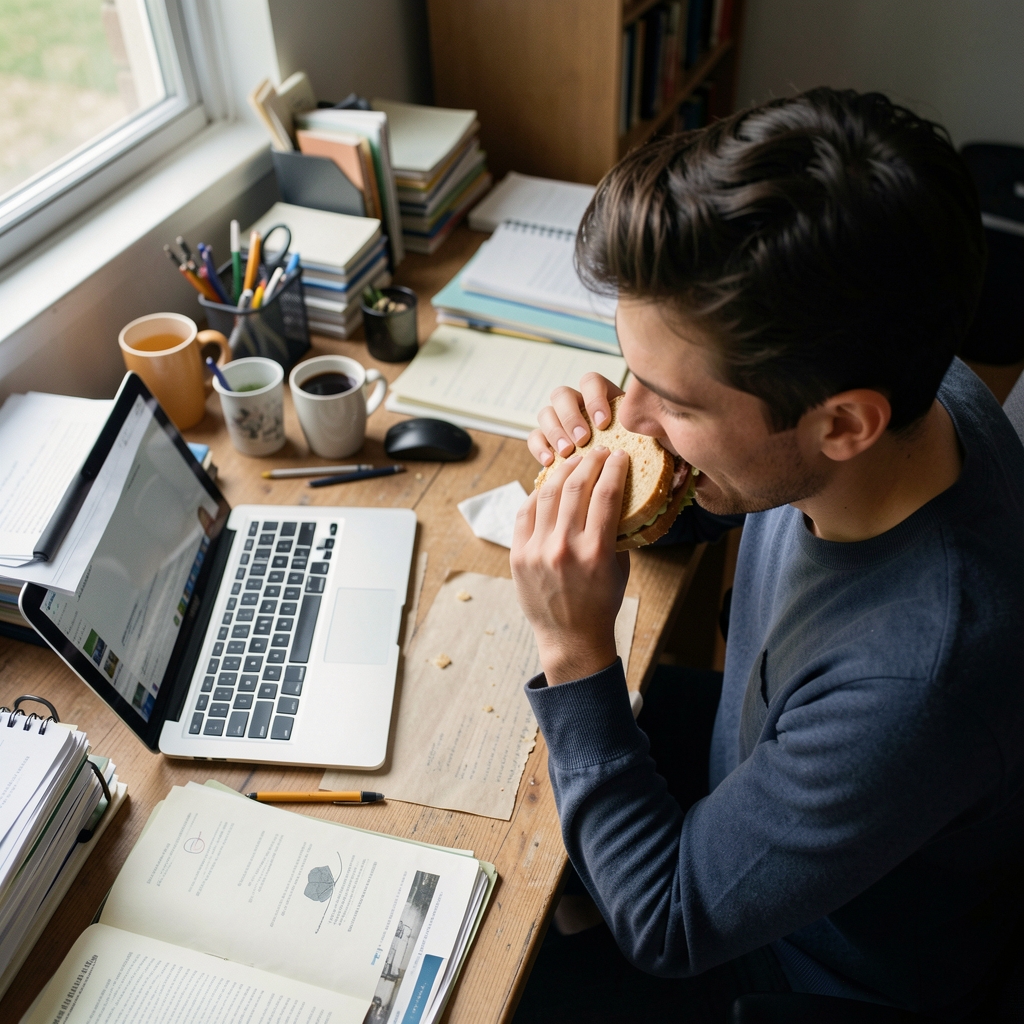
The week began with a pre-packed sandwich and a small bag of crisps from the corner shop downstairs. I ate at the keyboard, eyes on a document, finishing in seven minutes by the clock on the screen. The flavour, to the extent I registered it, was satisfactory. The experience of eating — the act of sitting down and consuming a midday meal — was effectively absent. Within thirty minutes I was reaching for a biscuit from the tin on the shelf, not from any particular awareness of wanting one, but because the hand moved in that direction without consultation.
This is, I recognise, an ordinary account of an ordinary Tuesday habit described on a Monday. What strikes me in the writing of it is not the speed itself, but the absence of any marker in memory — no moment of taste, no pause, no decision to stop. The meal simply ended when the container was empty.
Tuesday: A Warmed Portion, Still at the Desk
On Tuesday I brought leftovers. A warmed portion of rice with vegetables, eaten from the container with a fork. Duration: eleven minutes. The improvement in duration did not correspond to any noticeable improvement in attention. The food was warm and had been prepared with some care the previous evening, yet the meal environment — the same desk, the same open browser tab, the same background hum of notifications — reproduced the same conditions as Monday. Eleven minutes felt both longer and shorter than seven.
There is a body of published dietary research suggesting that slower eating is associated with greater meal satisfaction. This distinction — between pace and attention — seemed particularly relevant at the eleven-minute mark. Eating more slowly did not, in this case, mean eating more attentively. The pace had extended; the attention had not followed.
Wednesday: The Working Lunch Myth
Wednesday brought a scheduled meeting over the lunch hour, which was resolved by eating before the meeting began — a rapid sequence of bites taken standing at the kitchen counter, the container still in hand. Duration: four minutes, forty seconds. No seat. No pause. No particular occasion.
The convenience food choices available in the immediate vicinity of the office — the corner shop, the supermarket two streets along — are designed for exactly this kind of consumption. The portion is pre-determined; the container is disposable; the meal can be eaten standing, walking, or at a keyboard. The format of the food removes the need to make decisions about portions. It also removes the feedback loop that portion-making normally provides.
Research on food choices under time pressure notes that convenience food formats tend to produce consistent portion sizes regardless of the consumer's actual appetite at the time of eating. Wednesday was a five-hundred-calorie container consumed in under five minutes with no subsequent awareness of satiety — or its absence — until the middle of the afternoon meeting, when it surfaced as irritability.
Thursday: An Attempt at Slowing Down
On Thursday I tried a different approach. The same pre-packed container, from the same shop. But this time I moved from the desk to the small table in the kitchen area. I put the phone face-down. I ate without a screen in front of me. Duration: nineteen minutes.
The difference was not in the food — identical contents to Monday's purchase. The difference was in what I noticed. The texture of the bread. The temperature of the filling. The moment, somewhere in the middle of the meal, when I registered something that might plausibly be described as satisfaction. The afternoon did not involve a biscuit from the tin.
Slow eating practice — the intentional deceleration of meal pace — has been associated in published research with greater awareness of post-meal appetite and a more measured eating rhythm overall. Thursday's data point is a single observation by a single writer, not a claim about consistent outcomes. But it is notable nonetheless.
- — Monday: 7 minutes, screen present, no attentive pause. Subsequent snacking within 30 minutes.
- — Tuesday: 11 minutes, screen present, leftovers. Pace extended; attention unchanged.
- — Wednesday: 4 min 40 sec, standing, convenience food. No satiety awareness until mid-afternoon.
- — Thursday: 19 minutes, no screen, away from desk. Satiety noted mid-meal. No subsequent snacking.
- — Friday: 14 minutes, partial screen use. Mixed result — brief attention, then drift.
Friday: The Drift Back
Friday began with Thursday's intention intact. A different location, no laptop open. But a message arrived on the phone at the table midway through eating, and the meal reverted: the phone face-up, the attention redirected, the remaining contents consumed in the manner of Monday rather than Thursday. Duration: fourteen minutes, with a split in attention that rendered the latter portion of the meal essentially invisible.
This is, perhaps, the more representative data point. The conditions that produce distracted eating are persistent and systematic; the conditions that support attentive eating require active maintenance. Thursday was a single deliberate deviation from a well-established routine. Friday was the routine reasserting itself at the first available opportunity.
The Pattern Behind the Week
Taken together, the five days produced a picture of eating pace that is not unusual for an office-based working adult in London. The average duration across the five lunches was approximately eleven minutes. Monday, Wednesday, and Friday involved full or partial screen use; only Thursday involved none. The meal environment — desk versus separate table — was a more consistent predictor of eating pace than any other variable logged.
The relationship between eating pace and food choices is bidirectional. Convenience food formats support a fast eating rhythm; a fast eating rhythm, in turn, makes convenience food formats easier to accept. The desk lunch exists within both of these conditions simultaneously. It is a compressed version of a meal, taken in a compressed location, within a compressed portion of the working day.
What the week's notes suggest — without prescribing any particular change — is that the meal environment shapes eating pace in ways that extend well beyond the individual's deliberate choices at the time of eating. The table is a different object to the desk. The nineteen minutes and the seven minutes are not merely different durations; they are different experiences of the same act.
A Note on Method
This dispatch is a field record by a single writer over five consecutive weekdays. It is not a study, does not contain a control group, and is not intended to demonstrate any particular finding in the manner of peer-reviewed research. It is an observation, made with as much precision as was practical. It references published research where that research is relevant to the observations made, but it does not claim to replicate it.
Readers with specific concerns about their eating patterns are encouraged to speak with a qualified wellness or nutrition professional. This publication presents editorial observation — it does not offer personal guidance for individual circumstances.