London, March 2026. The screen at a meal is not simply a distraction. It is a parallel meal — a stream of stimuli consumed alongside the physical one, competing for attention without competing for appetite. Over the course of a week in early March, I kept notes on every meal eaten in the presence of a screen, and every meal eaten without one. The contrast was less dramatic than expected. The uniformity was more so.
The Screen as a Meal Companion
There is a long history of things placed near food that were not the food. Books, newspapers, the radio, conversation — the meal has rarely been a solo performance. The screen is the contemporary version of this arrangement, distinguished from its predecessors primarily by the directness of its demand on attention and by its availability at every meal, everywhere, for most people.
What changes when a screen is present at a meal is not principally the content of the food or the size of the portion. What changes is the quality and consistency of attention directed at the eating act. Reading a newspaper at breakfast divides the attention; a social media feed on a phone divides it more frequently and in smaller increments. The result is a meal experienced as a series of brief intervals between screen checks rather than as a continuous act.
Published research on eating and screens — including studies on television eating, phone use at mealtimes, and screen-based work during lunch — generally notes a consistent relationship between screen presence and eating pace. Meals eaten alongside screens tend to be shorter in duration, involve less awareness of food texture and flavour, and produce less reliable post-meal appetite feedback. This is not a new finding. It is, however, a finding that has become progressively harder to act on as screens have become more pervasive.
The Week in Notes: Screen-Present Meals
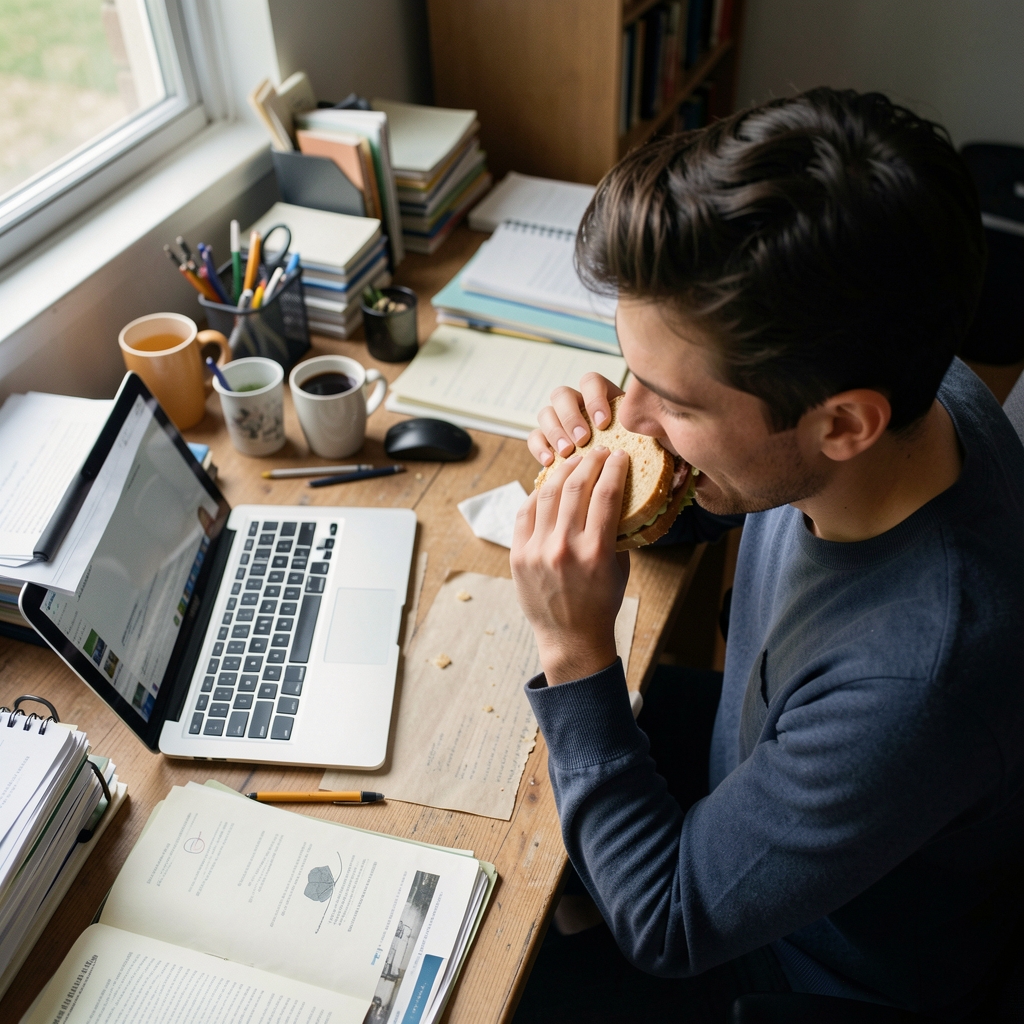
Monday, 1:12 PM: lunch at the desk, browser open, three tabs active. A warm pasta dish from a nearby counter, eaten with a fork from a cardboard container. Duration: ten minutes. The meal was consumed during the continuation of a task I had not paused to begin eating. The transition from working to eating was invisible; the transition from eating back to working was equally so. At 2:45 PM I ate two biscuits.
Tuesday, 12:48 PM: the same desk, phone face-up beside the keyboard. A different meal — a salad box, considerably larger in volume than the pasta. Duration: twelve minutes. The phone generated three notifications during the meal, each of which I checked. The intervals between checking were occupied by eating at a rate that I would not have maintained in the absence of the phone. The salad box was empty; I had not noticed it emptying.
Wednesday, 1:04 PM: eating while watching a news programme on a laptop, away from the desk but seated with the device. Duration: twenty-one minutes. This was a screen-present meal, but a different category of screen — passive viewing rather than active task. The meal was considerably slower. I noticed the food mid-meal. The programme was in the foreground; the eating was in the background; the result, paradoxically, was a more attentive meal than Monday or Tuesday.
The Hierarchy of Screen Types
Wednesday's observation introduced a distinction that the week's subsequent notes reinforced: screen-present meals are not uniform. The nature of the screen engagement — passive versus interactive, slow versus high-frequency — produces different effects on eating pace and attention. A passive medium (film, radio, television) that occupies the background tends to slow eating pace and increase meal duration; an interactive medium (task work, social feed, messaging) that demands frequent attention tends to compress it.
This distinction is rarely captured in the broad category of "screen time at meals", which regards a film on television and an email inbox as equivalent distractions. They are not equivalent. The interruption patterns are different; the attentional demands are different; and the relationship with the meal experience is correspondingly different.
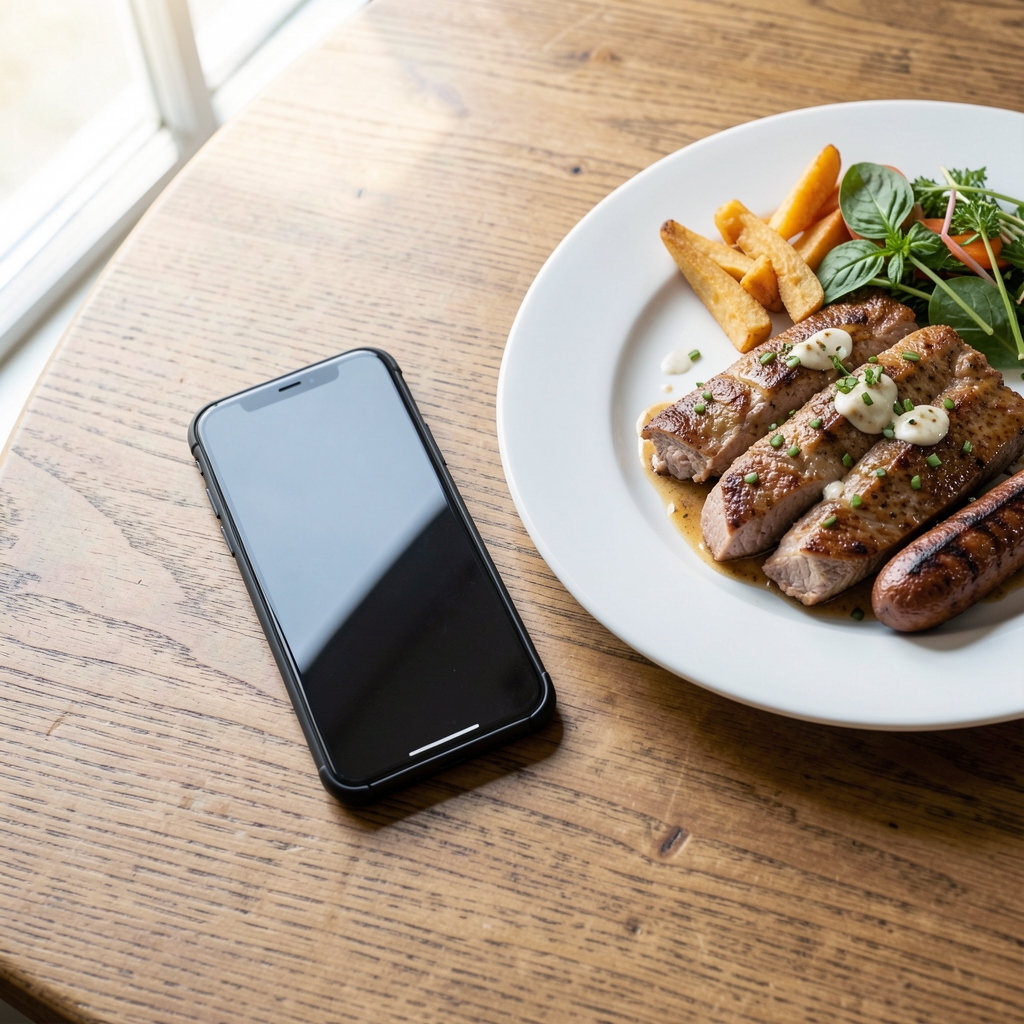
Thursday's notes confirmed this. A podcast playing through headphones while eating a home-prepared meal at a table. Duration: twenty-four minutes. No other screen present. The podcast occupied attention in a continuous rather than interrupted way — no notifications, no visual stimuli, no motor action required. The meal was the primary sensory experience. I noted the flavour of the food, the temperature at various points in the meal, and the arrival of a distinct sense of having eaten enough, approximately two-thirds of the way through the portion on the plate.
- — Active task screen (work browser): 10–12 min meal duration, no satiety awareness mid-meal.
- — Interactive phone (notifications active): 12 min, awareness of food minimal, appetite signals absent until 2+ hours post-meal.
- — Passive television/film: 21 min, background-foreground reversal produced moderate food attentiveness.
- — Audio-only (podcast, music): 24 min, highest food attentiveness of week, satiety awareness noted mid-meal.
- — No screen, home table: 27 min. Full attentiveness. Stopped before plate was empty.
Friday: The Phone Removed
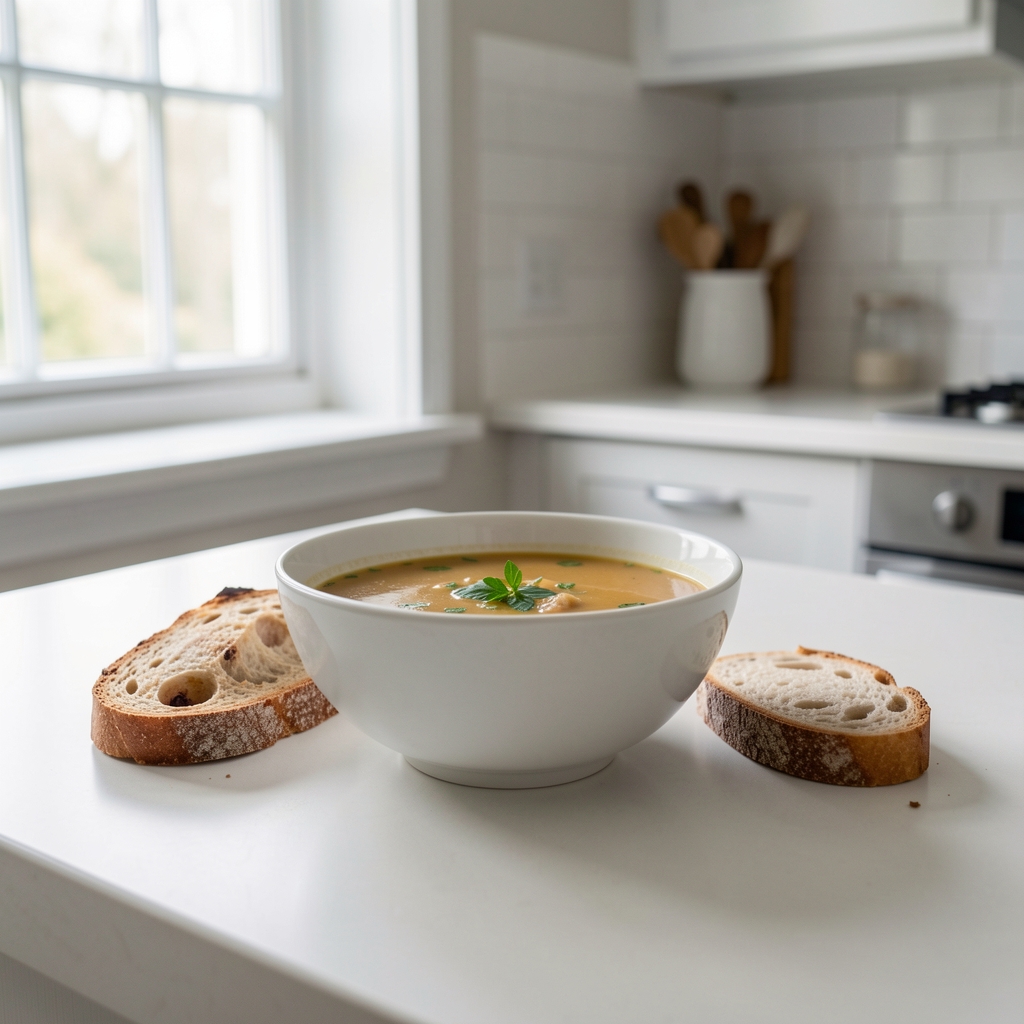
On Friday, by way of experiment, I left the phone in the other room during the midday meal. No television. A book placed near the table but not opened. The meal: a bowl of soup and bread, prepared at home, eaten at the kitchen table. Duration: twenty-seven minutes. I stopped eating before the bowl was entirely empty — the first time this had occurred during the week.
The meal had a beginning, a middle, and an end. This is a banal observation about something that is ordinarily true of meals. It struck me as worthy of note because Monday through Thursday had not produced this structure. Those meals had beginnings and ends — the opening of the container, the disposal of the container — but no discernible middle. The middle had been occupied by a screen.
The distinction between eating with and without a screen is not simply a matter of attention. It is a matter of what the eating experience is constructed from. Without a screen, the meal is built from food, from appetite, from the physical act of eating and the incremental awareness of what the body is receiving. With an active screen, the meal is constructed primarily from the screen content, with eating as an accompanying activity. The meal and the screen are not equally matched companions. One is designed to hold attention; the other requires attention to be meaningful.
The Pace of Modern Eating
The pace of modern eating is in large part a screen question. Screens do not create fast eating, but they create the conditions in which fast eating is the default — because they fill the time that attentive eating would otherwise occupy. A ten-minute meal consumed at a keyboard is not ten minutes of eating; it is ten minutes of work, with eating distributed across it at whatever pace the body manages without conscious oversight.
There is nothing inherently wrong with this arrangement if the primary aim is efficiency. The difficulty arises when the eater also expects to derive some satisfaction from the meal — some awareness of what was eaten, some post-meal ease, some sense of having completed a distinct portion of the day. These outcomes require some degree of attentiveness during the meal. Attentiveness is exactly what the screen displaces.
The week's notes produced no recommendations. They produced a log of what different eating contexts look like in practice, and what they tend to produce in terms of eating pace, food awareness, and subsequent appetite patterns. Whether any of that matters to any particular reader depends on what they are looking for from their meals. This publication records observations; it does not recommend outcomes.
Slow Eating Practice as an Environmental Variable
What the week's observations suggest about slow eating practice is that it is less a personal discipline than an environmental variable. The reader who takes a phone to every meal will tend to eat faster than the reader who does not, not because of any deficiency of intention, but because the environment they have arranged does not support a slower pace. The phone is not a willpower problem; it is a furniture arrangement.
The practical question — whether to remove the phone from the meal, whether to pause the screen — is not one that this dispatch will answer. It is a question about priorities, about what a meal is for, about what the working day can accommodate. These are individual questions with individual answers. What can be offered here is a record of what the different arrangements produce: the meal at the desk, the meal at the table, the meal with a screen, the meal without one. Each produces something. The records are here.
Readers with specific concerns about their eating habits or overall wellbeing are encouraged to speak with a qualified wellness or nutrition professional. The content of this dispatch reflects one writer's observations across one week in one location, not a general directive about eating behaviour.